
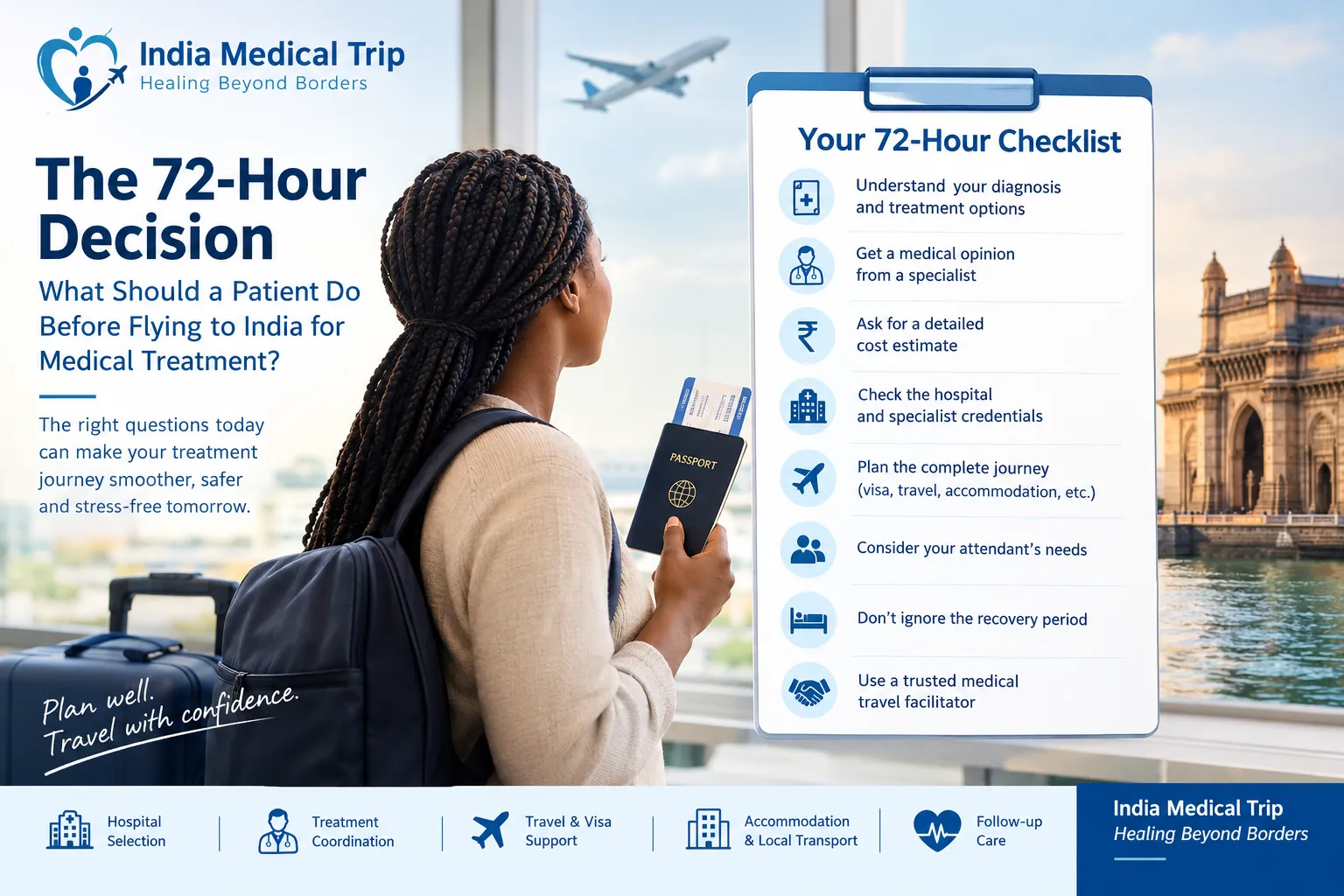
The 72-Hour Decision: What Should a Patient Do Before Flying to India for Medical Treatment?
Imagine this.
You have been told that you or someone in your family needs surgery.
You have heard that India has experienced specialists and advanced hospitals. Someone sends you a hospital name on WhatsApp. Another person recommends a different doctor. Someone else gives you a price that sounds attractive.
Then the questions begin:
Which hospital should I choose?
Which doctor should I consult?
How much will it really cost?
Should I travel now or get another medical opinion?
What documents do I need?
Where will my family stay?
For an international patient, the most important decision may not be the flight booking.
It may be what happens during the 72 hours before deciding to travel.
Step 1: Don't Start With the Hospital — Start With the Medical Problem
One common mistake is searching for a hospital before properly understanding the patient's medical requirement.
Start by collecting:
- Recent medical reports
- Blood test results
- Imaging reports
- CT/MRI/X-ray scans
- Previous prescriptions
- Previous surgery records
- Current medications
- Doctor's diagnosis
- Any relevant pathology or biopsy reports
The objective is simple:
Give the Indian specialist enough information to understand the case before the patient boards a flight.
Digital healthcare is making this increasingly practical, with international patients able to share medical records and communicate with doctors before travelling. Research published in 2026 also highlights digital platforms as an important part of building confidence in medical tourism.
Step 2: Get a Medical Opinion Before Booking Your Flight
A quotation is not the same thing as a treatment plan.
A patient should first understand:
What is the diagnosis?
What treatment is being recommended?
Is surgery actually necessary?
What alternatives exist?
How urgent is the treatment?
Where appropriate, an online consultation with a qualified specialist can help the patient understand the possible treatment pathway before travelling.
This can save time, money and unnecessary travel.
Step 3: Ask for a Detailed Cost Estimate
Never ask only:
“How much does the surgery cost?”
Ask what the estimate includes.
For example:
- Doctor consultation
- Hospital admission
- Surgeon fees
- Anaesthesia
- Operating-room charges
- Room charges
- Medicines
- Diagnostic investigations
- ICU charges, if required
- Follow-up consultations
Also ask what may not be included.
Unexpected medical expenses can arise if the patient's condition requires additional investigations, medicines, procedures or a longer hospital stay.
A transparent estimate is therefore more useful than simply finding the cheapest quotation.
Step 4: Check the Hospital and Specialist
A low quotation should never be the only reason to select a hospital.
International patients should investigate:
Hospital credentials
Specialist experience
Relevant department
Accreditation and quality standards
International-patient services
Follow-up arrangements
India's Medical Value Travel ecosystem is increasingly emphasizing quality, patient-centric care and internationally oriented healthcare services rather than price alone.
Step 5: Calculate the Real Cost of Treatment
The hospital quotation is only one part of the financial calculation.
The actual medical trip may include:
**Medical treatment
- Flights
- Visa
- Accommodation
- Food
- Local transportation
- Attendant expenses
- Medicines
- Follow-up consultations**
For some patients, particularly those travelling with family members, accommodation and living expenses can become significant.
Therefore, compare the complete journey cost, not just the hospital quotation.
Step 6: Think About the Attendant
Many international patients travel with a spouse, parent, child or another family member.
Before travelling, determine:
- Who will accompany the patient?
- How long might they need to stay?
- Where will they stay?
- How will they travel between the hotel and hospital?
- What happens if the patient's hospitalisation is extended?
Medical travel is not only a patient's journey.
It is often a family journey.
Step 7: Don't Ignore the Recovery Period
This is one of the most overlooked parts of medical tourism.
Suppose the surgery takes two hours.
That does not mean the patient can necessarily fly home two hours later.
The patient may require:
- Hospital recovery
- Follow-up consultation
- Wound review
- Physiotherapy
- Medication adjustment
- Medical clearance before travel
The treating doctor should determine when the patient is medically fit to travel.
The 72-Hour Checklist
Before making the final travel decision, an international patient should ideally have answers to these questions:
1.What is my diagnosis?
2. What treatment has been recommended?
3. Have my medical reports been reviewed by the appropriate specialist?
4. Have I discussed possible treatment alternatives?
5. Which hospital will treat me?
6. Who is the treating specialist?
7. What is included in the estimated treatment cost?
8. What additional expenses are possible?
9. How long might I need to stay in India?
10. Where will I stay?
11. Who will accompany me?
12. What documents do I need for travel and medical treatment?
13. What follow-up care will I need?
14. When can I safely return home?
If you cannot answer several of these questions, you may not be ready to book the flight yet.
The Real Value of a Medical Travel Facilitator
A medical travel facilitator should not simply say:
“We can arrange your hospital appointment.”
The real value is coordination.
A patient travelling internationally may need help connecting several pieces of the journey:
Patient → Medical Records → Specialist → Hospital → Treatment Estimate → Visa → Travel → Accommodation → Hospital Visit → Recovery → Follow-up
India's government has recently emphasized the importance of seamless patient journeys, trained caregivers and stronger coordination within the Medical Value Travel ecosystem.
That is why medical tourism is increasingly becoming Medical Value Travel.
The objective is not simply to move a patient from one country to another.
It is to create a coordinated healthcare journey.
Before You Fly, Ask Better Questions
Choosing treatment abroad is a major decision.
Do not choose a hospital simply because someone forwarded its name on WhatsApp.
Do not choose a treatment only because the price looks low.
Do not book a flight before understanding the medical plan.
Instead:
Understand the diagnosis.
Review the treatment options.
Speak with the appropriate specialist.
Understand the complete cost.
Plan the journey.
Prepare for recovery.
Then make an informed decision.
India Medical Trip — Healing Beyond Borders
At India Medical Trip, we help international patients explore healthcare options in India and coordinate the practical steps involved in their medical journey.
From understanding medical requirements and connecting with healthcare providers to treatment coordination and travel support, our objective is to make the journey clearer and more organised for patients and their families.
Your treatment journey should begin with information — not confusion.
India Medical Trip
Healing Beyond Borders